is this selling "old technique" (RAG) by a new name ("Precomputed Context"),
to show that keeping large context for chat may be expensive.
but in reality cost of cached tokens on server is much smaller than new tokens (text).
maybe KnowQL is new element? Gemini's explanations is "confident", but is it "correct?"
Moving Beyond RAG with Precomputed Context - Software Engineering Daily
KnowQL gives agents the vocabulary they are missing. Six core primitives: intent, filter, provenance, output shape, confidence, and budget, in a single declarative interface that returns trusted knowledge — structured, precise, and grounded. Composable across the heterogeneous knowledge sources that real enterprise AI requires.
Instead of reassembling disjointed context chunks on the fly during every user query, it treats context as a first-class, pre-packaged asset.
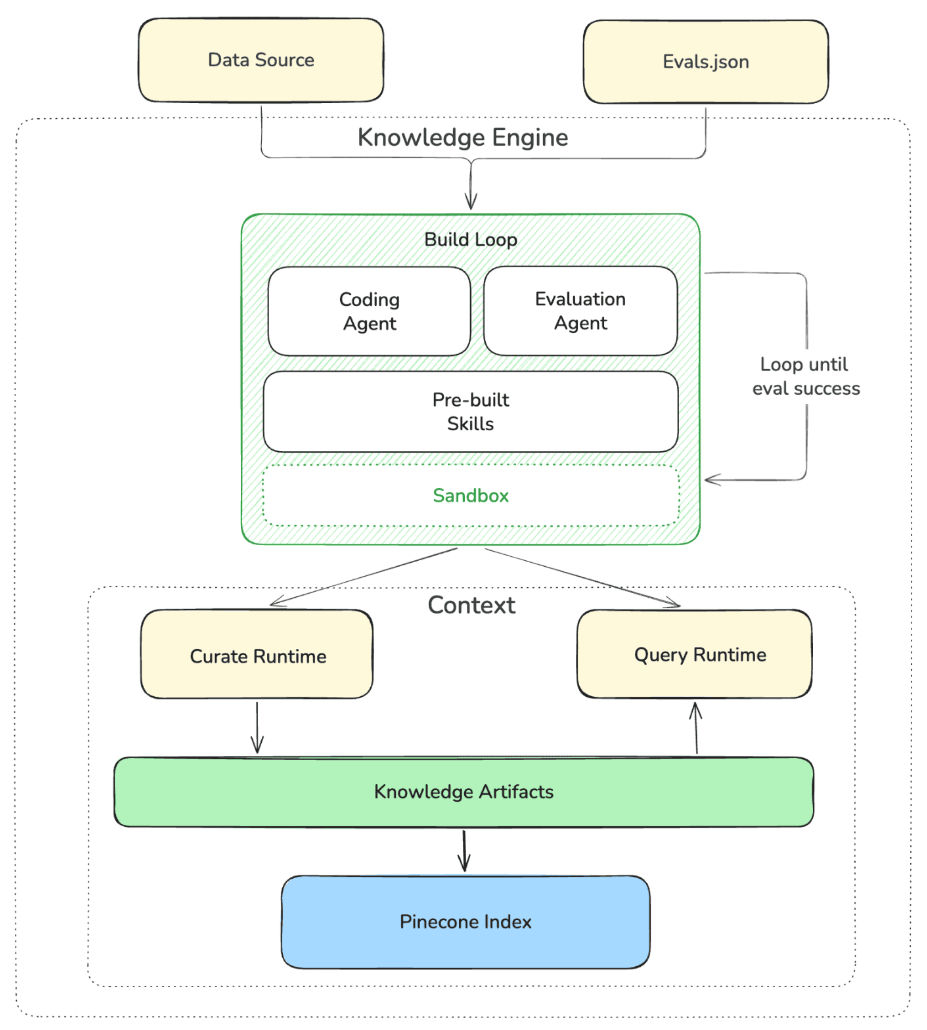
Pinecone powers this paradigm natively through its Pinecone Nexus knowledge engine, treating precomputed context much like a database treats a "materialized view".
How Precomputed Context Works Step-by-Step

1. Ingestion and The Context Compiler
2. Materialization into "Context Artifacts"
- Lineage: A clear audit trail tracking precisely where the information came from and when it was created.
- Schema & Typed Fields: Strongly typed definitions so downstream LLM agents can instantly parse the data structure.
- Permissions: Governance rules enforced directly at the data layer, ensuring sensitive vectors are completely hidden from unauthorized queries.
3. Low-Latency Composable Retrieval
- It resolves conflicting information deterministically.
- It shapes the output exactly how the specific AI agent requested it.
| Feature | Traditional RAG | Precomputed Context (Pinecone Nexus) |
| Computation | Assembled on-the-fly for every single query. | Computed once, saved, and reused infinitely. |
| Consistency | Probabilistic. The same question can yield different context sets. | Deterministic. Delivers reproducible answers. |
| LLM Costs | High. Frequently relies on massive context windows and redundant processing. | Up to 90% reduction in token usage by offloading reasoning to the database. |
| Data Security | Relies on application-level prompt filtering. | Permissions enforced at the database level. |
Core Benefits
By shifting the heavy contextual reasoning from the inference call to the storage engine, systems built with precomputed context see massive performance spikes. It eliminates the "Lost in the Middle" problem where LLMs overlook crucial facts buried inside overstuffed prompts, resulting in dramatically faster time-to-completion and higher task success rates for complex autonomous agents.
The Contrast: Old RAG vs. KnowQL & Nexus
| Feature | Same Old RAG | Pinecone Nexus + KnowQL |
|---|---|---|
| What is Stored | Raw text chunks + raw mathematical vectors. | Precompiled "Knowledge Artifacts" (summarized, structured, reconciled data packages with built-in access controls and metadata). |
| The Database Interface | Vector math query (e.g., Cosine similarity search on an array of floats). | KnowQL: A declarative query language where you tell the DB exactly what you want back, not how to calculate distance. |
| What is Returned | A list of 5–10 unstructured text blobs. | A single, highly structured, typed, and cited JSON-like data object. |
| LLM Workload | High token burn. The LLM has to read all 10 chunks to synthesize an answer. | Low token burn. The DB already synthesized the data into an answer template before handing it back. |
What is KnowQL?
- Intent: The actual question being asked and the specific knowledge scope.
- Filter: Strict, deterministic rules (like security permissions/RBAC) applied directly at the database layer.
- Provenance: Built-in, field-level citations. The database tracks exactly which document source verified which specific piece of data.
- Output Shape: A structural guarantee. You can dictate the exact JSON format or typed fields you expect back.
- Confidence: A score telling the agent whether a fact is rock-solid or an uncertain inference.
- Budget: You can specify maximum latency targets (e.g., "return under 500ms") or token limits. [1, 5, 9, 10, 11, 12]
A Practical Example of the Difference
- With Old RAG: Your app queries Pinecone for vectors, gets back 20 pages of messy financial statements, sends all 20 pages to OpenAI, and pays for millions of prompt tokens while the model attempts to calculate totals and resolve conflicting data. [4, 9]
- With KnowQL: The agent submits a structured request to the database. Pinecone’s Context Compiler has already cross-referenced those text documents ahead of time, compiled them into a clean knowledge artifact, and hands back a pre-verified, structured table with direct citations. [2, 4]
The Query
What makes this different from RAG?
- No
top_k: 10: The system does not specify how many raw document fragments to retrieve. - Deterministic Filtering: The database layer enforces access control (
user_clearance) and firm metadata restrictions before looking at knowledge artifacts. - The "Shape" Contract: The query strictly dictates a typed schema for the return payload (
account_name,renewal_date, etc.). [5, 6, 7, 8]
The Output
Why this saves token costs
The Core Difference: Caching vs. Compiling
- A Cache stores Questions and Answers. If the user doesn't ask the exact same question (or a close paraphrase), the cache is useless.
- Pinecone Nexus/KnowQL compiles the underlying source data into generalized, structured schemas before any query is asked. [1, 2, 5, 6, 7]
A Real-World Analogy: The Messy Room
1. The Same Old RAG Way:
2. The Cache Way:
3. The KnowQL / Compilation Way:
- When a user asks a completely unique, never-before-seen question (e.g., "Show me all contracts signed in Q3 where a competitor was mentioned"), the system doesn't read the raw papers. It translates that question into a KnowQL structural query and hits the compiled tables. [8, 9]
Summary
- Grab a raw document. [4]
- Instead of just blind chunking, you run it through a prompt like: "Extract all entities, reconcile conflicting dates, summarize the core facts, and output a clean JSON map."
- Save that structured summary (the text) alongside its vector embedding into your database, tagged with strict metadata for roles and access control. [5]
So why did Pinecone build this?
- The Cross-Document Problem: Doing slight pre-processing on a single text chunk is easy. But what happens if Doc A says "Acme Corp signed the contract on Tuesday" and Doc B says "Acme Corp delayed the contract to Friday"? Pinecone's compiler attempts to act as a background state-machine to resolve those cross-document conflicts before you query them. [6]
- The Custom Database Layer: If you save custom JSON summaries in your database, your application code has to write custom parsers, state handlers, and retry loops to make sure the LLM gets the exact format it needs every time. KnowQL provides a standardized SQL-like contract (
output_shape) so your app code doesn't have to keep changing every time your data structures change. [2] - The "Black Box" of Prompts: Managing security permissions (RBAC) inside unstructured text chunks is a nightmare. By introducing a hard query layer with rigid primitives (
filter), they are forcing data governance to happen at the database level rather than praying the LLM respects a system prompt. [1, 7]
The Verdict
1. "Knowledge Compilation" & "LLM Wikis"
- OpenKB (Open Knowledge Base): An open-source framework built exactly around this. They explicitly contrast themselves with "traditional RAG". OpenKB uses an LLM pipeline at ingest time to compile raw data into automatically updated, cross-linked "concept pages" and "summaries" so that knowledge compounds over time rather than being re-derived during every search. [4]
- RAGFlow (Knowledge Compilation feature): RAGFlow introduced a formal "Knowledge Compilation" layer. They use terms like "Tree / Graph / Timeline Compilation". Instead of parsing raw chunk fragments, their ingestion pipeline converts disorganized enterprise files into structurally mapped timelines or mind maps before an agent ever queries them. [5]
2. "Context Compilation" & "Decision Bundles"
- Context OS by Elixir Data: This platform uses the exact phrase "Decision-Grade Context Compilation." Their core argument is that "Context is not retrieval." They pull information from multiple separate enterprise databases simultaneously, compile it down into a highly condensed "decision package" (e.g., stripping a 12,000-token multi-document search down to a clean 847-token package), and enforce state boundaries before handing it to an AI agent. [6]
- OpenViking: An open-source context database built for AI agents. It features a built-in
ov compiletool that automatically triggers background extraction when a data session closes, organizing source material into an optimized wiki or context layer so agents can read high-level abstractions rather than searching across raw file directories. [7]
3. Graph-Based Semantic Compilation
- Microsoft GraphRAG: While Microsoft calls it "GraphRAG," the community widely defines its backend mechanism as a form of knowledge compilation. Before a query occurs, GraphRAG forces an LLM to read all text chunks, extract every entity, and map out a massive global knowledge graph. When you query it, you aren't doing a vector math search; you are querying a pre-compiled summary of the entire macro-dataset. [3]
Summary of the Vocabulary Shift
- Compile-Time RAG: Moving the retrieval and reasoning loop completely outside the live user request path.
- Minimum Viable Context (MVC): Forcing the data pipeline to find the absolute tightest, smallest set of constraints and metrics required to answer a prompt, preventing token bloat.
- Provenance Engines: Built-in metadata schemas tracking exactly which source document or row generated a synthesized fact. [1, 2, 8]
Does LLM Wiki make vector retrieval RAG pointless?
No. They solve different problems.
RAG solves “quickly locate relevant fragments in a large document collection.” It works for one-off queries against large corpora that don’t need deep synthesis. You have 100k customer support conversations, a user asks about a specific product issue, RAG finds the relevant ones in milliseconds. You don’t need and can’t afford to pre-compile a wiki for that.
LLM Wiki solves “continuously accumulate and synthesize knowledge from a manageable document collection.” Document count is moderate (tens to hundreds), but inter-document relationships are complex and need long-term maintenance.
Put differently: RAG is a search engine, LLM Wiki is an encyclopedia. You wouldn’t organize 100k support tickets like an encyclopedia, and you wouldn’t do a three-month literature review with a search engine.
The RAG community is already moving in this direction. Microsoft’s GraphRAG builds a knowledge graph before retrieval — essentially a form of knowledge compilation. LLM Wiki goes further: the compiled artifact isn’t a graph but human-readable documents. Both share the same judgment: query-time retrieval alone isn’t enough; you need structural processing at ingest time.

No comments:
Post a Comment