3D Gaussian Splatting (3DGS) is a cutting-edge 3D reconstruction and rendering technique that converts 2D images or video into highly detailed, photorealistic 3D scenes. Unlike traditional mesh-based methods, 3DGS uses millions of tiny 3D Gaussians (spheres/points) optimized via machine learning to represent scenes, enabling real-time, high-fidelity rendering for VR/AR and 3D modeling.
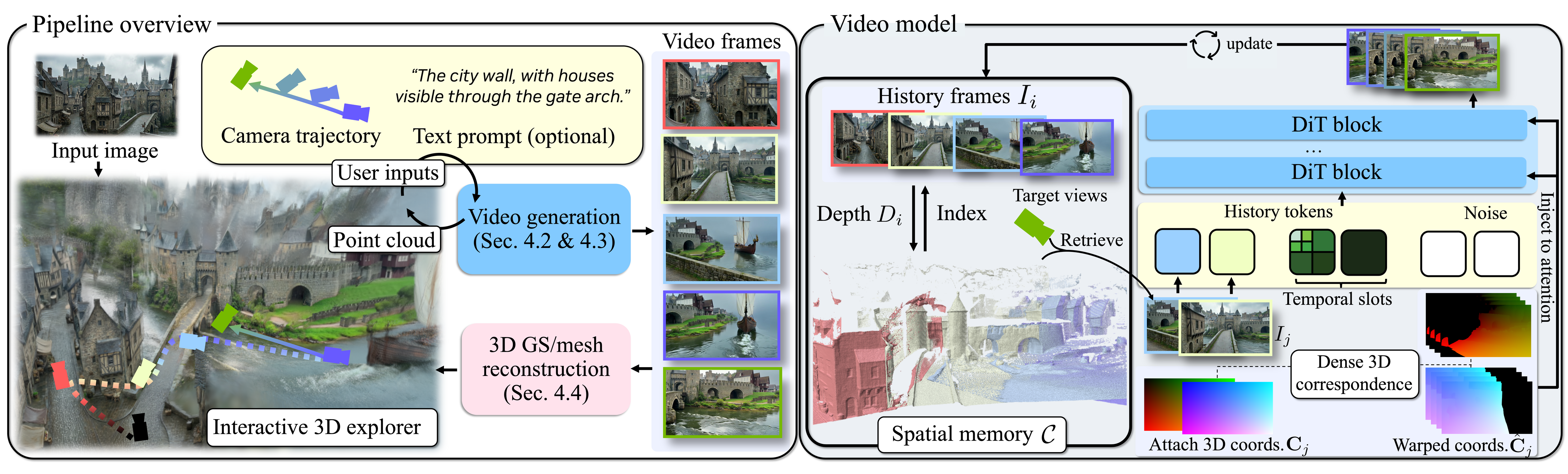
Method overview. (Left) Given an input image, Lyra 2.0 iteratively generates video segments guided by a user‑defined camera trajectory from an interactive 3D explorer and an optional text prompt, lifting each segment into 3D point clouds fed back for continued navigation. Generated video frames are finally reconstructed and exported as 3D Gaussians or meshes. (Right) At each step, history frames with maximal visibility of the target views are retrieved from the spatial memory. Their canonical coordinates are warped to establish dense 3D correspondences and injected into DiT via attention, together with compressed temporal history.
Shapes Constraint Language[1] (SHACL) is a World Wide Web Consortium (W3C) standard language for describing Resource Description Framework (RDF) graphs. SHACL has been designed to enhance the semantic and technical interoperability layers of ontologies expressed as RDF graphs.
SHACL (Shapes Constraint Language) is a W3C standard language used to validate and describe
RDF graphs by enforcing structural rules (shapes) on data. It ensures RDF data conforms to required formats (e.g., specific datatypes, cardinalities), acting as a validation schema. SHACL is designed to work directly with RDF and uses SPARQL for complex validations.
What is SHACL?
Shapes Graph: Defines constraints using node shapes (about the node) and property shapes (about values connected to the node).
Data Validation: It checks a "data graph" against a "shapes graph" to ensure compliance.
Capabilities: It ensures data quality, validates RDF against structural requirements, and can define constraints such as mandatory fields, data types (e.g., xsd:string), or valid value ranges.
Relationship to RDF
Native RDF Integration: SHACL shapes themselves are expressed in RDF, usually via the Turtle format.
Validates Data Graphs: SHACL operates directly on RDF triples (graphs), validating subjects, predicates, and objects.
Class/Instance Validation: It often targets RDF instances of specific classes within a dataset.
Relationship to SPARQL
Backend Engine: SHACL-SPARQL is an extension mechanism where validation constraints are defined as SPARQL queries.
Complex Rules: While core SHACL handles basic validation, SPARQL is used for complex cross-property or complex structural validation rules.
Query Transformation: A SHACL processor can transform shape definitions into SPARQL queries to validate data.
SHACL vs. RDF Schema/OWL
RDF Schema (RDFS) and OWL are used for inferencing (deriving new knowledge), while SHACL is used for validation (checking if data is right).
SHACL provides a standard way to validate that RDF data matches the intended structure and content constraints.