Previous "AI Sputnik Moment" what a few months ago when Deep Seek demonstrated significant performance, and "wiped out" $1T of stock market value in a day.
Why is this one even more significant?
SPUTNIK AI MOMENT - by Peter H. Diamandis - Metatrends
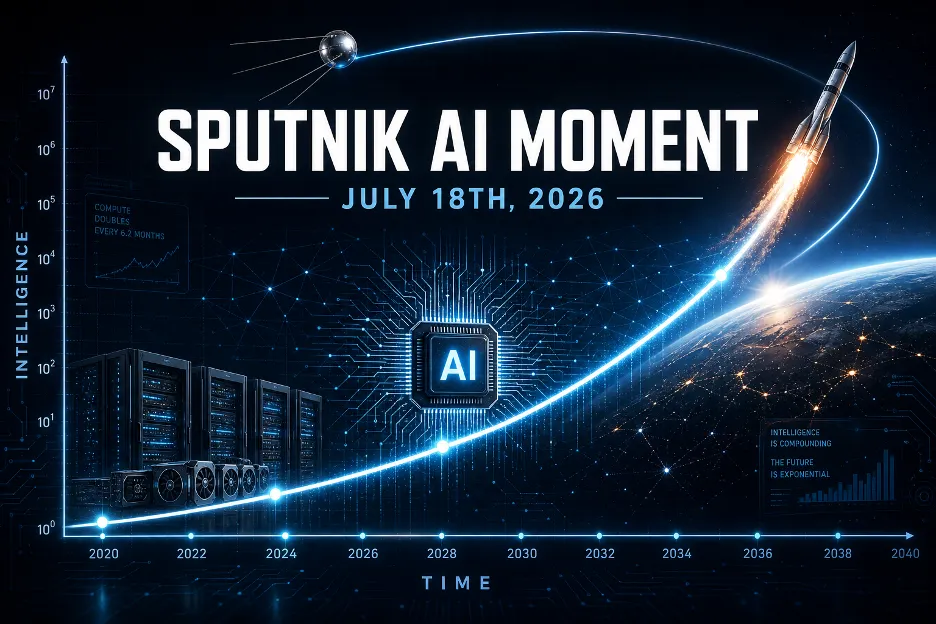
China’s "Sputnik Moment" with Kimi K3: Moonshot AI released Kimi K3, a massive 2.8 trillion parameter open-weight model that took the #1 spot on leaderboards. Despite US chip export controls, China trained it using older Nvidia H800s supplemented by domestic Huawei and Alibaba silicon.
Perishable Model Dominance: Frontier models now have a shelf life measured in weeks rather than months. Diamandis advises enterprises to stop standardizing on single models and instead build modular architectures that can swap models in and out easily.
Recursive Self-Improvement & Price Drop: Models are optimizing their own kernels, drastically lowering compute costs. Combined with binary/ternary quantization and local model advancements, AI intelligence is becoming "too cheap to meter."
Policy Backfire:
Export Embargoes: Instead of crippling Chinese AI, US chip restrictions forced Chinese labs to excel in quantization and compute efficiency.
Immigration Bottlenecks: Top talent educated in the US (such as CMU graduate and Moonshot AI CEO Yang Zhilin) are returning home due to visa restrictions, accelerating foreign innovation ecosystems.
Kimi K3 Delivers Frontier AI at 1% of the Cost: AI Sputnik Moment w/ Emad Mostaque | Ep. 272 - YouTube @Moonshots with Peter Diamandis
Based on the shared YouTube page for the emergency episode of Moonshots with Peter Diamandis, here is a summary and the key points concerning the release of the Kimi K3 AI model:
Summary
In this urgent update episode of the podcast, host Peter H. Diamandis sits down with recurring tech guest Emad Mostaque to discuss what is being called an "AI Sputnik Moment." The conversation centers around the sudden release of Moonshot AI's Kimi K3 model out of China, which reportedly delivers frontier-level AI capabilities and tops major benchmark leaderboards at just 1% of the cost of traditional Western frontier models.
Key Points
The 1% Cost Breakthrough: The defining milestone of Kimi K3 is its ability to match or exceed frontier-level performance while drastically cutting down operational and training costs to a fraction (1%) of what top US labs spend.
Topping the Benchmarks: As shown in the episode's data, Kimi K3 has achieved top rankings on highly competitive leaderboards, including the Frontend Code Arena, General Agents (such as JobBench), Automation Bench, and Visual Agents.
The "Largest Opweight Model": The video highlights K3's architecture as a massive breakthrough in operational efficiency and weight optimization, fundamentally changing the economics of running large language models.
An "AI Sputnik Moment": The rapid velocity of Chinese AI development—specifically catching up to and potentially overtaking American labs despite severe hardware and chip constraints—is framed as a major geopolitical shift in tech supremacy.
The Push for Open Models: Guest Emad Mostaque heavily advocates for pro-open models, emphasizing a philosophical shift toward the idea that "intelligence wants to be free" rather than locked behind proprietary, zero-sum corporate walls.

Moonshot AI limits Kimi access on overwhelming demand | LinkedIn
"Moonshot AI has paused subscriptions to its latest artificial intelligence model after demand exceeded capacity. "Kimi K3 has received far more love than we expected, and our GPUs are feeling it," Moonshot wrote on X. The Chinese startup that has upended Silicon Valley with its open-weight AI system said it hoped to resume offering new subscriptions shortly. Moonshot's new model sent markets spiraling over the weekend after delivering performance that rivaled American rivals OpenAI and Anthropic, suggesting it could provide cheaper coding agents."
Developer: Moonshot AI (China)
Scale & Access: 2.8 Trillion parameter open-weight model with a 1 Million token context window.
Architecture: Uses Kimi Delta Attention (KDA) and Attention Residuals to optimize efficiency and long-context performance.
Capabilities: Native visual understanding, long-horizon coding, knowledge work, and complex reasoning.
Benchmark Performance: Beats Claude Fable 5 on several key long-horizon benchmarks (including BrowseComp, ProgramBench, SWE-Marathon, and Arena's Frontend Code) while competing closely with proprietary models like Claude Fable 5 and GPT-5.6.


