Wednesday, February 25, 2026

Android PC: Android + ChromeOS ("Aluminum OS " 2026)

Google confirms Android-PC merger launches next year | The Tech Buzz

Excited About Android for PC? This Leak Gives Us First Glimpse of New OS | PCMag

Google plans to replace ChromeOS with a new platform called Aluminium OS, combining the best of its existing computing software with Android. We may now have seen the first glimpse of the software, but not as Google would have intended.

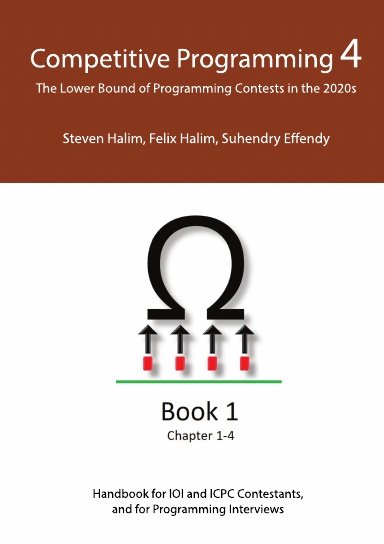
Book: Competitive Programming CP4

To "compete" with AI, one may need this book :)

Competitive Programming Book

"This Competitive Programming book, 4th edition (CP4) is a must have for every competitive programmer. Mastering the contents of this book is a necessary (but admittedly not sufficient) condition if one wishes to take a leap forward from being just another ordinary coder to being among one of the world's finest competitive programmers."

Competitive Programming Book CP4


Competitive Programming 4 - Book 1: The Lower Bound of Programming Contests in the 2020s: Halim, Steven, Halim, Felix, Effendy, Suhendry: 9781716745522: Amazon.com: Cell Phones & Accessories

Competitive Programming 4 - Book 2: The Lower Bound of Programming Contests in the 2020s: Halim, Steven, Halim, Felix, Effendy, Suhendry: 9781716745515: Amazon.com: Cell Phones & Accessories


 stevenhalim/cpbook-code: CP4 Free Source Code Project (C++17, Java11, Python3 and OCaml) @GitHub

"objective in writing this book is similar with... to further improve humanity by training current students to be more competitive in programming contests. 

The possible long term effect is future Computer Science researchers who are well versed in problem solving skills. 

We use C++ (primary), Python (secondary), Java (tertiary), and OCaml (optional) code to illustrate the algorithmic concepts, i.e., we dislike vague pseudo-code commonly found in many other Computer Science textbooks. 

We also built and heavily use our-own visualization tool: VisuAlgo to help explain the data structure and algorithm concepts to our book readers and beyond."


Monday, February 23, 2026

AI: Gemini 3.1 Pro: high intelligence, low price

Google's New AI Is Smarter Than Everyone's But It Costs HALF as Much. Here's Why They Don't Care. - YouTube

What's really happening when Google ships the smartest AI model on the planet, prices it at a seventh of the competition, and doesn't care if you keep using Claude or ChatGPT? The common story is that this is another benchmark race—but the reality is more interesting when the company generating $100 billion in annual free cash flow is playing a fundamentally different game.

javascript package manages: pnpm vs npm

pnpm vs npm | pnpm

"npm maintains a flattened dependency tree as of version 3. This leads to less disk space bloat, with a messy node_modules directory as a side effect.

On the other hand, pnpm manages node_modules by using hard linking and symbolic linking to a global on-disk content-addressable store. This lets you get the benefits of far less disk space usage, while also keeping your node_modules clean. There is documentation on the store layout if you wish to learn more.

The good thing about pnpm's proper node_modules structure is that it "helps to avoid silly bugs" by making it impossible to use modules that are not specified in the project's package.json."

Sunday, February 22, 2026

Code Is Cheap. Software Is Expensive?

What happens now? - YouTube by Theo - t3․gg - YouTube

Code Is Cheap Now. Software Isn’t. — Chris Gregori

1. The Collapse of the Barrier to Entry

  • Point: Building functional code is no longer a privilege held only by professional developers.

  • Justification: Tools like Claude Code and Claude Opus 4.5 allow non-technical "builders" to architect their own tools (e.g., subscription trackers or niche Chrome extensions) simply by describing what they need.

2. The Rise of "Disposable" Personal Software

  • Point: We are moving away from permanent SaaS platforms toward ephemeral "scratchpad" software.

  • Justification: Because the cost and time to generate code have dropped so low, it is now viable to build a tool for a single, one-off task and discard it immediately after, similar to how one uses a spreadsheet for quick calculations.

3. Code is Cheap; Software is Expensive

  • Point: Writing lines of code is easy, but building robust, real-world software remains difficult.

  • Justification: LLMs can generate syntax, but they don't solve for "the friction of the real world," such as maintenance, edge cases, UX debt, and breaking changes in third-party APIs or DOM structures.

4. The Shifting Role of the Engineer

  • Point: The value of a software engineer has moved from the "how" (syntax) to the "what" and "why" (systems).

  • Justification: AI hides complexity rather than managing it. Engineers are still required for architectural rigor—knowing how to manage distributed caches, rate-limiting, and data security—tasks that AI-native "weekend apps" often fail to address.

5. Distribution is the New Bottleneck

  • Point: Engineering leverage is no longer a primary differentiator for a business.

  • Justification: Since anyone can generate a product quickly, the competitive advantage has shifted to factors that are harder to automate: taste, timing, and a deep understanding of the audience. The hardest part is no longer building, but "finding a way to get people to care."


AI-Powered Flutter App with Antigravity

 How to Build an AI-Powered Flutter App with Google Antigravity: A Hands-On Tutorial @freecodecamp

use Antigravity to let AI agents plan, write, test, and show video walkthroughs of your app. This “vibe coding” style means that you describe what you want, review plans, and approve changes – all while agents handle the heavy lifting.


Saturday, February 21, 2026

AI Agents: machine that builds the machine

Build the machine that builds the machine | LinkedIn
Paul Dix
Cofounder and CTO at InfluxDB, series editor on Addison Wesley's "Data & Analytics


Building the machine that builds the machine with Paul Dix, Co-founder & CTO at InfluxDB (Changelog Interviews #676)

Paul Dix joins us to discuss the InfluxDB co-founder’s journey adapting to an agentic world. Paul sent his AI coding agents on various real-world side quests and shares all his findings: what’s going to prod, what’s not, and why he’s (at least for a bit) back to coding by hand.
Update: He’s back to letting the AIs write code, but with a lot more oversight. For now


AI tool: SmolAgents by Hugging Face

 Understanding AI Agents and Agentic AI: Concepts, Tools, and Implementation with SmolAgents @CodeMag

Today, there are numerous frameworks available for building AI agents, each offering its own philosophy and strengths. Popular options include SmolAgents by Hugging Face, LangChain, LangGraph (both by LangChain, Inc.), and Microsoft’s AutoGen. Although all of them support agent development, they differ in complexity, flexibility, and intended use cases.
In this article... focus on building agents using SmolAgents, a lightweight and developer-friendly Python framework.

huggingface/smolagents: 🤗 smolagents: a barebones library for agents that think in code. @GitHub


Friday, February 20, 2026

AI models: Gemini 3.1 Pro, Sonnet 3.6

Google launches Gemini 3.1 Pro, retaking AI crown with 2X+ reasoning performance boost | VentureBeat

The most significant advancement in Gemini 3.1 Pro lies in its performance on rigorous logic benchmarks. Most notably, the model achieved a verified score of 77.1% on ARC-AGI-2.

This specific benchmark is designed to evaluate a model's ability to solve entirely new logic patterns it has not encountered during training.

This result represents more than double the reasoning performance of the previous Gemini 3 Pro model.


  • Input Price: $2.00 per 1M tokens for prompts up to 200k; $4.00 per 1M tokens for prompts over 200k.
  • Output Price: $12.00 per 1M tokens for prompts up to 200k; $18.00 per 1M tokens for prompts over 200k.
  • Context Caching: Billed at $0.20 to $0.40 per 1M tokens depending on prompt size, plus a storage fee of $4.50 per 1M tokens per hour.
  • Search Grounding: 5,000 prompts per month are free, followed by a charge of $14 per 1,000 search queries.

Introducing Sonnet 4.6 \ Anthropic

Claude Sonnet 4.6 is most capable Sonnet model yet. It’s a full upgrade of the model’s skills across coding, computer use, long-context reasoning, agent planning, knowledge work, and design. Sonnet 4.6 also features a 1M token context window in beta.

For those on our Free and Pro plans, Claude Sonnet 4.6 is now the default model in claude.ai and Claude Cowork. Pricing remains the same as Sonnet 4.5, starting at $3/$15 per million tokens.


Anthropic just dropped Sonnet 4.6... - YouTube Matthew Berman


DotNet/C#: DB => Mermaid charts

 SimonCropp/DbToMermaid: Generate Mermaid ER diagrams from SQL Server databases or Entity Framework Core models. @GitHub


Entity Relationship Diagrams | Mermaid

Thursday, February 19, 2026

Docker Sandboxes (for AI code)

Docker Sandboxes | Docker Docs

Docker Sandboxes lets you run AI coding agents in isolated environments on your machine. Sandboxes provides a secure way to give agents autonomy without compromising your system.

Why use Docker Sandboxes

AI agents need to execute commands, install packages, and test code. Running them directly on your host machine means they have full access to your files, processes, and network. Docker Sandboxes isolates agents in microVMs, each with its own Docker daemon. Agents can spin up test containers and modify their environment without affecting your host.
 cd ~/my-project
 docker sandbox run AGENT

Replace AGENT with your preferred agent (claudecodexcopilot, etc.). The workspace defaults to your current directory when omitted. You can also specify an explicit path:

 docker sandbox run AGENT ~/my-project


AI Agent Workflows projects @GitHub

 𝟭𝟬 𝗵𝗶𝗴𝗵-𝗾𝘂𝗮𝗹𝗶𝘁𝘆 𝗚𝗶𝘁𝗛𝘂𝗯 𝗽𝗿𝗼𝗷𝗲𝗰𝘁𝘀 𝘁𝗵𝗮𝘁 𝘁𝗮𝗸𝗲 𝘆𝗼𝘂 𝗳𝗿𝗼𝗺 𝗳𝘂𝗻𝗱𝗮𝗺𝗲𝗻𝘁𝗮𝗹𝘀 𝘁𝗼 𝗽𝗿𝗼𝗱𝘂𝗰𝘁𝗶𝗼𝗻-𝗴𝗿𝗮𝗱𝗲 𝗮𝗴𝗲𝗻𝘁 𝘄𝗼𝗿𝗸𝗳𝗹𝗼𝘄𝘀:
by Andreas Horn (IBM) @ LinkedIn

1:// Hands on Large Language Models (18.7k ⭐)
https://lnkd.in/gQmyPJKk

2:// Microsoft’s AI Agents for beginners (47.3k ⭐)
https://lnkd.in/gFFppw-A

3:// Made With ML practical ML & GenAI projects (45.2k ⭐)
https://lnkd.in/g45cNEuP

4:// GenAI agent tutorials and implementations (18.7k ⭐)
https://lnkd.in/gt9GXcPa

5:// Proven system prompts for building reliable agents (101k ⭐)
https://lnkd.in/gBcBnYp8

6:// Awesome Generative AI learning hub (22.4k ⭐)
https://lnkd.in/gaQViw7A

7:// Prompt engineering deep dive guide (67.9k ⭐)
https://lnkd.in/gg2mn5ES

8:// Real LLM apps with agents and RAG patterns (83.4k ⭐)
https://lnkd.in/gSFEVNip

9:// Practical RAG techniques and examples (23.6k ⭐)
https://lnkd.in/g-Y62FHv

10:// Curated MCP server implementations (76.9k ⭐)
https://lnkd.in/gbZyg5t5


Wednesday, February 18, 2026

EV: Tesla models with their alternatives

The Best Alternatives to Every Tesla - YouTube
by Auto Focus - YouTube

The video compares several Tesla models with their alternatives in different categories:

  • Tesla Model 3 (1:07) alternatives include:

    • Hyundai Ioniq 6 (1:32)
    • Polestar 2 (2:30)
    • Volvo EX30 (2:49)
  • Tesla Model Y (3:16) alternatives include:

    • BMW iX (3:37)
    • Cadillac Lyriq (4:21)
    • Genesis GV60 (5:08)
  • Tesla Model S (6:09) alternatives include:

    • Lucid Air (6:37)
    • Porsche Taycan (7:33)
    • BMW i5 M60 (8:11)
  • Tesla Model X (8:58) alternatives include:

    • Lucid Gravity (9:17)
    • Rivian R1S (10:02)
    • Volvo EX90 (10:59)
  • Tesla Cybertruck (12:10) alternatives include:

    • Rivian R1T (12:37)
    • Chevy Silverado EV (13:33)
    • Ford F-150 Lightning (14:40)


Agentic AI Frameworks

 Agentic AI Frameworks Under the Microscope: What Works, What Doesn’t


...selection includes both established platforms (AutoGPT, Semantic Kernel, and LangGraph) and emerging frameworks (Agno), spanning different approaches from multiagent collaboration systems to single-agent workflow orchestrators...


Tuesday, February 17, 2026

AI Agentic Development: Gas Town, Beads

Beads and Gas Town are experimental tools developed by software engineer and industry veteran Steve Yegge to pioneer agentic software development. They represent a shift from single-agent coding assistance toward managing "fleets" of AI agents, with a focus on solving the persistent memory and coordination challenges that arise when multiple AI agents collaborate on complex, long-running software projects.


 Gas Town, Beads, and the Rise of Agentic Development with Steve Yegge - Software Engineering Daily

"AI-assisted programming has moved far beyond autocomplete. Large language models are now capable of editing entire codebases, coordinating long-running tasks, and collaborating across multiple systems. As these capabilities mature, the core challenge in software development is shifting away from writing code and toward orchestrating work, managing context, and maintaining shared understanding across fleets of agents.

Steve Yegge is a software engineer, writer, and industry veteran whose essays have shaped how many developers think about their work. Over the past year, Steve has been exploring the frontier of agentic software development, building tools like Beads and Gas Town to experiment with multi-agent coordination, shared memory, and AI-driven software workflows."


AI: "Human in the Loop" weekly news

 Human in the Loop by Andreas Horn (IBM)

Weekly insights on AI agents, tools, and real-world use cases — for people building and leading in the AI economy.

Vibe Coding Tools 2026 - What to Use, When, Why

  • OpenClaw creator Peter Steinberger joins OpenAI→ OpenAI is doubling down on personal agents by hiring the builder behind the viral open-source assistant, while keeping the project alive as open source under a foundation model. 


tool: PostHog AI

strange name, interesting tool

 PostHog – We make dev tools for product engineers

"We're here to help product engineers build successful products
Literally every piece of SaaS that a product engineer needs.
This includes tools for building products, talking to customers, and making sense of all your customer data.
PostHog is a single platform for people who build things."


"While Salesforce hikes prices 6% annually, PostHog proves there's room for startups that do the exact opposite of what private equity-backed software companies typically do."


Monday, February 16, 2026

AI: Vibe-coded vs Engineer-Guided

𝗧𝗵𝗲 𝗩𝗶𝗯𝗲 𝗖𝗼𝗱𝗶𝗻𝗴 𝗟𝗶𝗲. : Andreas Horn @LinkedIn


Garbage in, garbage out

"Anthropic dropped their Economic Index, where they analyzed 2 million conversations across 117 countries. They found a near-perfect relationship between the sophistication of the human input and the sophistication of the AI output (r ≈ 0.925).

𝗠𝗲𝗮𝗻𝗶𝗻𝗴:
AI doesn’t elevate your thinking. It reflects it:
→ Prompt with PhD-level depth, context, and constraints - get depth.
→ Prompt shallowly, with nothing but vibes - get surface-level answers.

𝗧𝗵𝗶𝘀 𝗶𝘀 𝘄𝗵𝘆 𝘁𝗵𝗲 “𝗽𝗿𝗼𝗺𝗽𝘁 𝗲𝗻𝗴𝗶𝗻𝗲𝗲𝗿” 𝗻𝗮𝗿𝗿𝗮𝘁𝗶𝘃𝗲 𝗶𝘀 𝗺𝗶𝘀𝗹𝗲𝗮𝗱𝗶𝗻𝗴. 𝗧𝗵𝗲 𝗽𝗲𝗼𝗽𝗹𝗲 𝗴𝗲𝘁𝘁𝗶𝗻𝗴 𝗲𝗹𝗶𝘁𝗲 𝗿𝗲𝘀𝘂𝗹𝘁𝘀 𝗮𝗿𝗲 𝗻𝗼𝘁 𝗯𝗲𝘁𝘁𝗲𝗿 𝗮𝘁 𝗽𝗿𝗼𝗺𝗽𝘁𝗶𝗻𝗴:
→ They’re better at the job.
→ They have domain fluency.
→ They have judgment.
→ They can smell nonsense.
→ They know what “good” looks like.
→ They iterate instead of accepting the first shiny answer.
→ The prompt is just the wrapper.
→ The expertise is the gift."