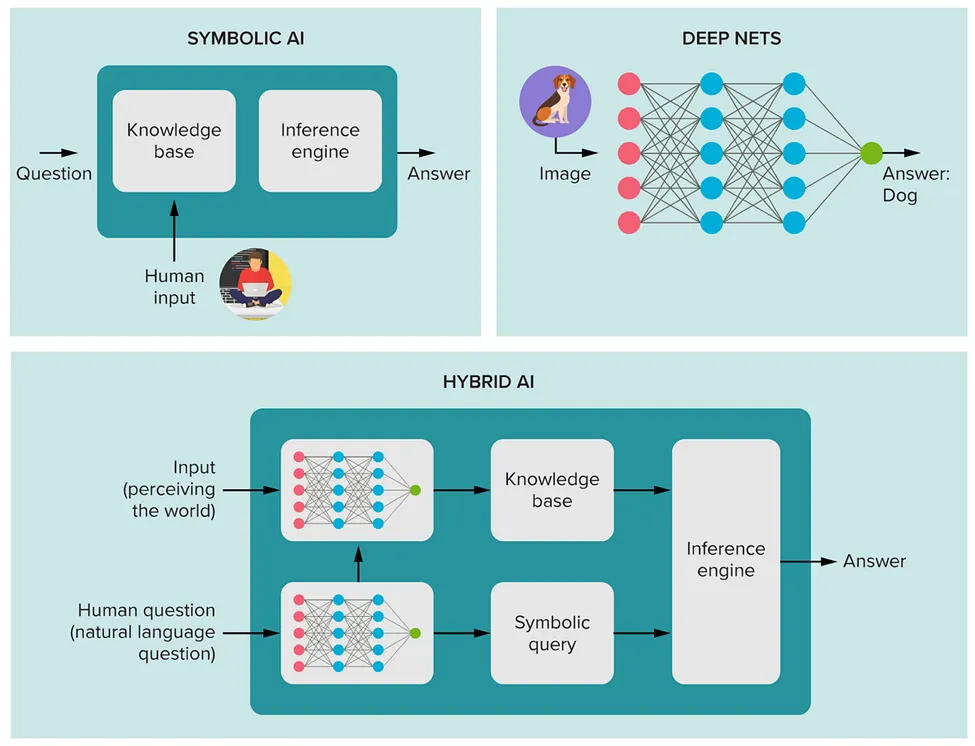

Neuro-symbolic AI works by creating a layered pipeline that fuses the statistical pattern recognition of neural networks with the deterministic, rule-based logic of symbolic systems. This hybrid architecture uses the "neural" side as a perceptual engine to ingest noisy, unstructured data (like text or images) and translate it into clear concepts. The "symbolic" side then steps in as a reasoning layer, running those concepts through strict rules, mathematical constraints, and corporate guidelines to ensure the final output is 100% accurate, safe, and fully auditable. [1, 2, 3]
The Core Practical Workflow
- Perception (The Neural Step): A neural network or Large Language Model (LLM) takes in raw, unstructured information. It identifies shapes, translates languages, or extracts raw intent from a user query. [1, 2, 3, 4, 5]
- Symbolic Translation: The system maps the neural model's continuous vector outputs into clear, distinct symbols—such as defined database entities, relationships, or programming variables. [1, 2, 3]
- Reasoning & Verification (The Symbolic Step): A symbolic engine (like a knowledge graph, a database rule engine, or logic programming) runs the translated symbols against known facts, calculations, or regulatory requirements. [1, 2, 3]
- Action or Feedback: If the output complies with all the hard rules, it executes safely. If a rule is broken or a mathematical error is detected, the system catches it, blocks the hallucination, and feeds the error back to self-correct the workflow. [1, 2, 3]

No comments:
Post a Comment